Friday, 12 April 2019

Voting preferences- Myths and realities


The nation had entered into an election mood. For the next 40 days, political leaders, opinion makers, intellectuals and all will dish out their opinions, commentaries, wish lists and ‘predictions’. Ordinary men and women will be deluged with all kinds of propaganda materials to catch their attention and swing their opinions.

Many amongst us may be resigned to the fact that politicians of all hues are making huge noises and grandeur promises without being result oriented. Why are they doing so? Are they really fooling the electorate or just play according to the rules of the game? Let us examine the election propaganda using some tools of behavioral science.

Image result for indian elections

a)      Recency bias-

This is one of the cognitive biases which are well exploited by Politicians all over the world. We, the common man always over-emphasis things which happened in the near past and under-appreciated things that happened long back. In practice, people remember the good or bad things done by a politician/incumbent government in the recent past. That is the reason why we see a flurry of inaugurations, stone laying, etc. Due to this bias, we tempted to support the leader who does maximum (good) things in the last few months than the one who did much better, but in earlier years.

Next time, when you see a ‘Neta’ does some inauguration or stone laying just before an election, don’t blame him. Just blame ourselves, as we all have a short memory and hence we will appreciate his good work (and vote him) only if it was done in the recent past.

This is the same reason why the Election Commission is imposing Model code of conduct so that voters won’t fall into the trap of this Recency bias. But our smarter Netas does inauguration just before Model Code come in to force.

b)     Barbarians at gates syndrome-

Many voters are vulnerable to this syndrome and then fail to make an intelligent choice. They are fed with an idea that every effort must be done to defeat the opponents who are portrayed as ‘barbarians’ and hence any kind of alternative is better. When this syndrome captures one's imagination, one will tempt to go any extent to prevent any victory for his opponents.  People, in this case, are ready to ally/ vote for anyone whom they believe can defeat the ‘barbarians’.

It is one of the best strategies to win the election as not much effort is required to put up an alternate plan and vision. Just create an impression that if you don’t vote to us, worst is waiting for you. It prevents our ability to think and our mental faculties are suppressed by this ‘fear of barbarians’.

In this election, the very strategy of ‘Mahagadbandhan’ and Congress is this only. If Modi comes again, they say, India will turn in to a Fascist state, Hindu rastra will be established, minorities will be driven away, etc. On the other hand, BJP would say, if not Modi, it is chaos and Nation will become a banana republic, so vote for us.

Fear is one of the primary driving forces for human initiatives. Our animalistic instinct will alert our brain about any impending threats to our life and limbs more quickly than any positive thoughts. Hence, don’t just blame our leaders. It is the way our human brains are wired. 
 
c)      Familiarisation bias –

Ever wondered why our candidates try to reach each lane and by-lanes of our residential area and roaming around public places and speak boring, same old kinds of stuff. Why he simply can’t send a letter to us and we can read about his ideas and program? The truth is that he wants to make sure that he meets the maximum possible number of people and as many people can see his face.

Voting preference of an average voter is highly influenced by the familiarity factor. Given a choice between two individuals, whose policies and ideas don’t make much sense to him; an average voter prefers a familiar face which he encountered at least once in front of his house. 

d)     Social proof- Why a leader organize mammoth rallies?

An average voter is not an isolated, unconnected individual and his political choices are always influenced by the opinions and choices of those nearby. Hence he would always try to ensure that as many people support a party which he supports. Most likely, he would also support a party/ candidate whom others would support in large number.

Political parties are aware of this psychological phenomenon and that is why they are organizing huge rallies and road shows. They are trying to bring maximum people together to assure each of them to see that there are many alike so that every body’s beliefs are reinforced and strengthened. We all are hungry for social approvals and wish to be an ‘included’ than being left alone.

e)      Halo effect-

Again, it is one of the shortcuts used by our brain to judge and evaluate a person. Leaders who want to get popular support take special care to see that they are always viewed by the people in a positive way. Intelligent leaders are very much bothered about the way in which they dress, body language, facial expression etc.

Ordinary people many times, won’t understand many of the policies of a particular leader, but they trust, support and vote him based on the ‘halo’ created around him over a period of time. 

This list is not exhaustive, but just an indicative one.  As voters and human beings, our rationality is not absolute and what we have is ‘Bounded rationality’.  No voter in this earth can calculate the impacts of all the policies of a leader and find whether those policies are beneficial or not. We have limited computational capacity, limited attention span, and biased reasoning. Hence the idea of ‘rational electoral choice’ is nothing but a myth.

Given these circumstances, our voting preferences are based on our cognitive biases and mental shortcuts we often use in expressing our political preferences. Hence, leaders and parties who can play with our biases and preferences will be able to muster maximum popular support.

Winning an election is a mental game. It’s about putting across new narratives, catchy slogans, and emotional appeals. Voters can be easily manipulated, cajoled, threatened by intelligent propaganda and communication strategies.

No voter would admit that he can be manipulated easily and he sincerely believes that his political preferences are based on rationality. Yet the truth is that most of us are unaware of our vulnerabilities and limitations. Hence, our Netas are not capitalizing our ignorance per se, but they are making use of our ignorance about our being ignorant.  


Wednesday, 13 February 2019

The great Indian Urban mess .


Contrast to cities in the developed world, urban India is a mess. What we see in a typical Indian city are shabby buildings, congested roads, encroached public spaces, pathetic state of garbage disposal, and a lot of such woes which we are all experiencing if we happens to live in any Indian city. Yet millions of young people are migrating from rural areas to urban India, leaving their farmland behind, in search of economic opportunities and better life style. 

People primarily blame their local Member of Parliament and MLA s, and many others for this state of affairs. Media often brings MP s, MLA s , Chief Ministers, when they talk essentially municipal issues like garbage, condition of roads, slum issues etc. We make these elected representatives responsible for all the ills because we essentially don’t know who the real culprit is. Let’s examine the issue in perspective and see where the real problem lies.

Image result for urban mess in indiaRoot cause of the issue of urban mess in India is that   we don’t have an urban leader in our cities. What we have instead is  multiple authorities operating in silos and sometimes at cross purpose. We have a Mayor post which is more like a titular head without much effective powers. Real executive powers are lying with a bureaucrat CEO who is appointed by Chief Minister and is accountable only to him.

Elected Councillors of our municipal bodies are mainly rent seeking, career politicians whose roles are limited to choosing Mayoral candidates. They play a minimal role in administration of municipalities. Meanwhile whole Municipal administration under the bureaucrat CEO is mainly concerned about garbage disposal, a few roads, water supply and sanitation, building permits, registration of births and deaths, a few public works etc.

Urban administration in developed countries is much different from what we have in our country. In those places, an elected Mayor is a very powerful entity, who looks after almost everything related to that city which includes appointment of Police chief who report directly to him.  He does have the power to tax, formulate land use pattern, prepare master plans, recruit and dismiss municipal bureaucracy, Engineers , firemen and all others whom he deemed fit for smooth functioning of his municipality.

Voters, in return can evaluate Mayor’s performance very clearly and can put all the blame on him if something gone wrong and can outvote him if wish so. Many times, Mayors are seen to be competing with each other for fresh investments and thereby creation of jobs and new tax revenue. We can recollect how cities and mayors vied for newly announced campus for Google. Let us recollect the  highly visible and commendable role played by Mayor of New York, Rudy Giuliani when 9/11 happened.

In many aspects, these mayors of capital cities are perhaps second most powerful authorities next only to Prime Minister/ President. In many countries, mayor post is a stepping stone for highest political offices of that country. 

Contrast to this is the way we see our Mayors. I am sure that very few people in our country know the name of mayor of their own city. He or she does have a limited role to play whenever any key decisions are taken. Most of the decisions and approvals pertaining to any cities are directly approved and monitored by Chief Minister/ Cabinet minister himself and are executed by concerned District collectors/ CEO s of municipality.

First step towards urban renewal in our country should be about real empowerment of our Mayors who should be a directly elected one and can appoint officers under him. Mayor should be a man/woman who should have enough financial resources and managerial bandwidth to take up every, matters related to urban administration and should have command over all the authorities and bureaucrat under that geographical area.
Image result for urban mess in india

Since he is an elected representative and if sufficiently empowered, he will be having a clear incentive to do things which are in the larger interest of his city as he will be always interested in re election. Further like in Developed countries, his political career and ambitions are directly connected to his Mayoral performance. This is unlike a bureaucratic Municipal commissioner who does not have any incentive to have a better administration for the city. Let us keep our MP s, MLA s, away from Municipal issues and let them concentrate on their legislative role.

Unlike other countries, there is a reason why Mayors in our country is a powerless entity. During freedom movement, Indian leaders were getting elected to Municipalities as popular representatives. Remember, Sardar Patel was the President of Ahmedabad municipality and so was Jawaharlal Nehru in Allahabad. British government was not ready to give sufficient powers and authority to these popular leaders and kept real executive powers with British bureaucrat in the form of CEO s and Governors of the provinces. After independence, the CM s and Commissioners continued to exercise these powers. Hence we continue to have the institutional legacy of British municipal administration.  Even the 73 rd and 74 th amendment couldn’t bring much needed changes.

There is a huge amount of institutional persistence when we talk about urban governance. Bureaucrats don’t want to cede any powers to an elected Mayor nor do our ‘All India Service’ officers want to serve under such commands.  Neither the CM s wants to bring any changes to this status-quo situation. An empowered mayor would be a real political rival to the incumbent CM. Besides no CM wish to lose control over the these cities, since much of the discretionary and rent seeking powers for the incumbents come from the land parcels, necessary approvals, building permits, infrastructure building etc.

Faster economic growth can happen only if we can re-imagine our cities as more vibrant, productive, environmental and people friendly.  If we want our cities to be transformed in that manner, we need to have a complete overhauling of our municipal administration from what we have today. However, what stops us from having a modern, accountable and incentive based Municipal administration is that it will be vehemently resisted by the present day authorities and power holders, who will be having much to lose.  


Wednesday, 5 December 2018

Popular fallacies of Public policy.


We often tempt to blame our government for all our economic woes. Popular media accuse government of the day for not creating enough jobs, price rise, exchange rate depreciation, farmer’s suicide, farm crisis and what not?. Let us see whether the government is really responsible for all these and if so, is it because of any omission or commission by the incumbent government?. Let us examine the issue in perspective.

We all agree that we are living in a market economy and not in a government controlled socialistic economy. In any market economy, prices are decided by the market participants through demand and supply dynamics. In other words, no government officer can dictate prices in a market economy. If the demand is high and supply is not matching towards it, naturally the prices will shoot up, which will compel people to consume less. When prices increase, more producers will be entering in to the market and hence after some time, prices will have to moderate.

Government simply can’t directly interfere in this market and ask the producers to reduce their prices. Of course, government can intervene to frame policies that will help to increase the production, increase level of competition, reduce entry barriers, if any, which will help more players to enter in to and produce more. Government can unleash competition by preventing any monopolistic tendencies and enforcing competition.

So, before blaming government for price rise, please see whether it was because of any particular action or inaction by the government that caused prices to increase. If not, wait for a while and let the market itself to correct it.

How many of us blame government for ‘unemployment crises’. Let us go back to our fundamental ideas. In any market economy, government don’t and can’t create any jobs. Jobs are created by firms, factories and entrepreneurs. They recruit and retrench people as per their need and production cycle.  Government can’t ask these people to create ‘more jobs’. At the best, government can give some tax concessions and subsidies for creating more employment but this can only be a short term solution that comes at the cost of tax payer’s money.

Instead, what the government can do is to create policies for promoting industrialization, exports, which includes provision for land at concessional rates, ease of approvals, providing physical and electronic infrastructure and many more. On the other side, government can ensure quality education which will churn out youngsters with necessary skill sets and are readily employable.

Thus, if we want to put the blame on government for not creating enough jobs, we will have to convincingly argue that because of these omissions and commissions, that the government can be blamed for job crisis.  Simple rhetoric of ‘unemployment’ cannot be put across against the government if it is not substantiated.

Similar is the issue of Farm crisis- Farmers are believed to be in a crisis as their products are not remunerative enough and hence the government is blamed for a ‘farm crises’. Opposition parties are taken up cudgel against the government for neglecting agriculture and farm sector.

As said earlier, no single individual can decide the price of any particular product including farm products. Because of improvement in production and storage technologies, we are living an era of abundant production. Prices are suppressed because demand has not been increased proportional to production. Market clearing price cannot be go up unless demands shoots up or supply drops down.

The main demand of protesters was that Minimum support price (MSP) may be declared on all agriculture products. If so, the prices of those items will be increasing and correspondingly, the consumption will come down. It will result in excess stock of the product which no one will be willing to buy.

Image result for farmer crisis in india
As per my early principle, government can’t dictate a price and expect other market participants to transact under this price. The government at best can subsidize the farmers and his produce. However, this unsustainable way of ‘protecting farmer’ will be too burdensome for other taxpaying citizens.

It may sound cruel, but the fact is that every individual farmer is an economic agent who will have to shift his production, techniques, and reallocate his resources according to the market price signals. It is the market prices and incentive structure that should guide his behavior and if not, he will remain a miser. He can’t put the onus on the government for not getting remunerative price for his product. If that’s the case, he should abandon his farm and look for some other gainful employment.

 If enough number of people leave farming and look for factory jobs, the remaining few farmers will get a reasonable income from their produce. Government in its side should encourage more people to discontinue farming and facilitate their migration to urban areas where they can be more gainfully employed. Only solution for the ‘farm crisis’ is factories and not MSP.

Let us learn few fundamental characters of a modern market economy and how it differs from a state dictated socialist economy. In any market economy, the role of the government is believed to be limited and it is not supposed to interfere in the market unless there is a market failure. It can influence prices, wages, interest rates, job creation etc only through its tax and fiscal policies which includes subsidies. Primary economic role of a government in a liberal market economy is to collect taxes and spend it wisely for the larger public interest. Any attempt to breach this role by interfering in prices or wages will have a serious negative impact even though it may appear to be attractive and beneficial for some.

 It may be our economic illiteracy or intellectual errors that prompt us to support these kinds of interventionist ideas. However, all these above mentioned popular fallacies are something in common. When somebody/ some group is perceived to be in a crisis, we wish to have quick-fix solution. This is because, these ideas appeals to man’s darker side which is primitive, non creative, dependent, non- productive and destructive side of human nature. These bad ideas are easy to define, articulate and spread faster.  But its end results are also equally disastrous in the long term. Despite, demonstratively failed in every country, this is the reason why still many of us are attracted to the socialist and communist ideas of this nature. It is a ponzi scheme whose initial illusion of success attract many, and seductive at times. However, end result will be always the tyranny of the government and misery for millions.  

Besides economic argument, there is another dark side of the whole issue. A modern liberal democratic government is based on a fundamental assumption that it will grant liberty to the citizens to pursue any legal economic activity and will respect the sanctity of private property. If government interferes too much, not only our economic freedom will be at peril, our political freedom will also be threatened. A Government which can dictate market prices can also dictate our private life. If government can enforce price control, it can enter in to our bed rooms and arrest us as well. After all, our economic freedom and political freedom are intrinsically interlinked.  As proverb goes, the road to hell is paved with good intentions.


Sunday, 14 October 2018

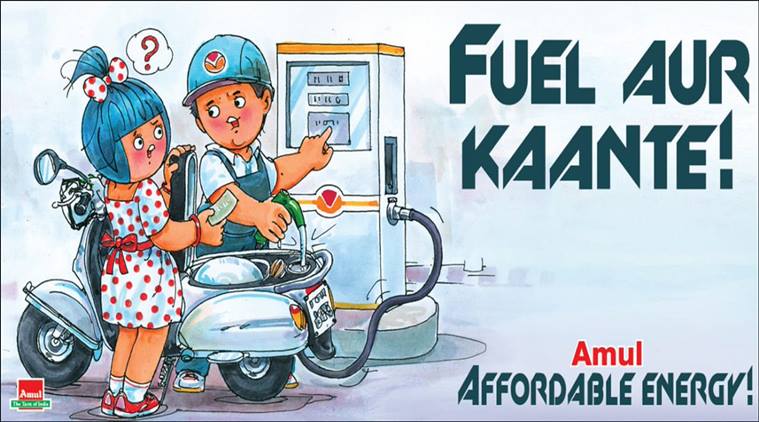
Petrol price rise and popular anger

Petrol and diesel prices have been skyrocketing for the last few months. The government of India, in its wisdom, decontrolled petrol/diesel prices a few years back and this eliminated petroleum subsidies which were at an unsustainable level. Since 80% of our hydrocarbon energy requirements are met through imports, any rise in crude price at the international market should result in upward movement of  petrol/ diesel pump price.

Mainstream, as well as social media, is flooded with comments that Central government is responsible for higher fuel prices and it is taxing heavily on it. Let us examine this issue in deeper.  

Sin good or engine of growth?

Contrary to popular belief, petroleum products are highly taxed commodities in most parts of the world except in the Middle East. There is a logic and rationale behind this high tax rates. Petrol is a unique commodity which can be termed as a Sin good whose consumption should not be encouraged because of the particular kind of ‘Public bad’ and negative externality it creates.

Image result for petrol price rise in india
Classical sin goods are those goods whose consumption is harmful to the individual consumer and hence considered harmful to the larger society as well. Cigarettes, junk foods liquor, etc are examples of such Sin goods, and hence are taxed heavily. However, petro-products are slightly different. Unlike Cigarettes, individual consumer of petrol, ie a private car owner, is a beneficiary of his own consumption while the adverse effect is borne by larger society. To make it simple, it is like this. A passenger inside a car is happy with the privacy and comfort he enjoys, while the men outside the car become a victim of the pollution that it creates. Hence, the consumer is bound to pay a tax for the ‘Public bad’ that he creates. Any decrease in tax will only encourage further consumption and more comfort to the car owner, while more pollution to the pedestrians and people living in that city.

However, people who don’t own the cars are also pinched by rising fuel prices because fares of public transports will also likely to increase. People in general henceforth will tempt to support lowering of prices and taxes without realizing that indirect costs borne by him through increased pollution and reduced government revenue (hence reduced government welfare measures) will be much higher than the benefit he accrues.

On the other hand, consumption and use of petro products are heavily interlinked with economic growth. When GDP and people’s income are growing, their transportation needs increases and hence consumption of energy is bound to grow. In this regard, any artificial suppression of energy consumption is bound to adversely affect economic growth and living standards. Hence government all over the world, try to do a tightrope walk by increased taxes and encouraging fuel-efficient economic activities. 

People refuse to believe that the higher pump price is the consequences of an increase in international crude price. Ordinary people often tempt to blame somebody when they perceive something is going wrong. We generally believe that when things go bad, it must be because of someone who would be conspiring against us. We always love to believe in conspiracy theories and hence like to blame 'evil businessman' who owns Oil companies, petrol pump owners, corrupt politicians for increasing oil tax etc. We ignore the reality that prices of crude oil are arrived by global market forces are based on a number of factors and India is simply a price taker in it. Yet, unfortunately, the central government is the favorite whipping boy in this matter
Image result for petrol price rise in india
We, as human beings, according to public health activist, Hans Rosling, is also infested with negativity instincts and notice bad things more than the good. We often misremember the past and tempt to think that petrol prices will continue to increase despite the truth that every commodity undergoes a price cycle.  Hence prices keep falling and rising but we remember only the pain points. Remember, when crude is rising, food prices like Dal, Grains, sugar etc became cheaper and inflation is at its lowest. We always have an illusion of deterioration, while the truth is that things are improving gradually.

In this context, if we ask any ordinary Citizens whether the government should 'reduce' the price (by cutting down tax rates), we will get an affirmative answer that the prices should be brought down. Many will even argue that Government should ‘fix’ petrol price as it was earlier, without knowing that the government was incurring huge and unsustainable subsidies for ‘fixing’ it.  If more probed on how then the government will find more resources or how it will reduce expenditure correspondingly, mostly we will get a blank look.

People want simplistic solutions to every complex economic issue and most people form opinions on their own without having any deeper understanding of complexities and intricacies of it. People falsely believe that government can fix the prices of commodities while the truth is that it can’t.  The primary economic activity of the government is to collect taxes and spend it wisely for the overall welfare of the people. Governments can, of course, influence prices of commodities through taxation, subsidies, regulatory frameworks, ensuring competition etc but can’t increase or decrease prices of commodities by its own. Any such move to control prices will result in disastrous consequences. The best form of government is the one which interferes least in the market prices.

People are also unaware and unsure of their earlier positions. Interestingly the same people who were supporting the Odd-Even scheme in Delhi (for reducing pollution) now want reduced petrol prices which will paradoxically increase pollution. In Kerala, it is the environmental activists, who were forefront in protecting paddy fields, now want cheaper petrol. Few months’ back media branded New Delhi as the worst polluted capital city in the world. Now, the same media want people to consume more petrol by reducing taxes on it. Similarly, the Right to Food activists who wants cheaper food for all, wants the petrol taxes to be reduced without knowing where the money for cheaper food will come from.  

However, there is no surprise to all these seemingly contradictory positions of individuals/activists and governments. In reality, according to author Yuval Noel Harari, we have multiple selves and each self, behave as per its own wishes and fanciful ideas. This contrarian and incompatible positions and opinions are very much a part of human existence in this world. Human minds have different drawers and compartments and each need not be talking to others. A human being can switch to different identities as the need arises and offer contradictory opinions on multiple issues without being aware of inconsistencies in their own arguments. 

The best way for the government is to ignore and sidestep any demand for ‘reducing’ petrol prices. Sure, people are angry towards the price increases. But once the price gets stabilized, in the medium to long-term, people get anchored to new prices and will either shift to new consumption curve or will change their consumption pattern accordingly. The finance minister should sit, relax and need not do much in this regard. Let the market forces play by its own and get it adjusted.  


Saturday, 8 September 2018

Reimaging a post-flood Kerala

Unprecedented floods have caused enormous devastation in the state of Kerala. An initial estimate suggests that the loss is about Rs 35000 crore while the actual loss may be even higher. Chief Minister of Kerala is appealing to all concerned citizens and foreigners to contribute generously to the Chief Ministers relief fund for rebuilding the state. He desires that every Keralite should contribute one month’s salary for this purpose.

While many have contributed their share, there is a strong perception that money may not be utilized efficiently. Whatsapp messages are flooded with people asking ‘unnecessary’ advisors, political appointees etc be shown door and minister’s ‘lavish’ lifestyle, their foreign trips etc be stopped immediately before asking ordinary citizens to sacrifice their one month salary.

Image result for kerala floods

While these ‘lavish expenditures’ are inviting public opprobrium, savings on account of curtailing such ‘lavish expenditure’ are insignificant. Apart from voluntary contributions, substantial resources for rebuilding Kerala can, however, also be mobilized by taking up reforms and restructuring some of the ‘untouched’ areas or holy cows. Many of them may be politically hot potatoes, yet apart from a resources point of view, such an overhauling will also be beneficial to Kerala in the long term. 


Some such options are given below.

a)      Ban on recruitment ( except for necessary services like Police, teachers, doctors etc)-

Kerala has a massive yet inefficient bureaucracy whose number is around 5 lakh (that does not include PSU s, Autonomous institutions and Local-self government bodies, Co-operate sector etc). State government spends around Rs 32000 Cr in a year for their wages alone and Rs 18000 Cr as Pension liabilities. This is against around 1.02 lakh crores of Revenue receipt that this state had last year. Most of these employees are generally unskilled and are employed at clerical levels. In this digital age, it is surprising why the government should have this much number of clerks in its payrolls. However, more surprising is that the government still continue to recruit thousands of Clerks and ‘Assistants’ every year.

The primary job of the Government is to provide its citizen quality Public Goods/Services. It can not provide jobs to a large number of these 'PSC aspirant youths' without inviting fiscal ruin. While nothing much can be done against those already in services, the least that the government should do is to stop any further recruitment. This will save at least a few hundred crores in the coming years.

b)      Privatise/ Disinvest State PSU s-

Agreed, this proposal is an ideological ‘No-go’ area for ruling Leftists. However, a crisis is a perfect opportunity for revising ideological positioning and to take up pragmatic policies based on economic reasoning.

We inherited an economy infested with such wasteful use of resources and can be rightly termed as Crony socialism. There are around 140 state PSU s in Kerala, and most of them are in red. All these PSU s together incur a huge drain of public money. Perhaps, the invisible cost to the society may be far higher, even if many are failing to understand its true social costs.

A few of them are profit-making only because of their monopoly rights (like Beverages co-operation). However, if privatized, most of them can fetch a good valuation mainly because they own precious land parcels in key locations. If the Kerala government is sincere on reconstruction and needed funds, the best way to mobilize is through privatization of these ‘assets’. As of today, they are white elephants guzzling a lot of public money and time has now ripened for pulling the plug. If we handover these PSU s to private entrepreneurs, besides earning a good fortune for government, it can also herald a new Industrial revolution in Kerala using these assets.

c)      Monetise the land-

Kerala government, through its departments and various other bodies, owns huge land parcels in many cities and most of them are either under-utilized or are simply vacant. A correct figure in this regard is not available to the public, yet the size seems to be substantial. Primary example in this regard is a huge land parcel that Kerala government owns in New Delhi near to Travancore house, which is left vacant because of some strange reason.

This land parcels may be sold to entrepreneurs/ builders/ tourism sector for better and efficient utilization and in the meantime government is ought to get a good amount of money as well. However, our crony socialist ideas taught us to keep these land parcels vacant rather than selling it to private entities at market rates. We often forget that land is just another economic asset which can be bought, sold, leased, mortgaged. It doesn’t have a divinity or sanctity attached to it, nor does such market transaction can be called as parting our ‘family assets’.

d)     Increase service charges and user fees-

In Kerala, most of the services offered by the government are either free of cost or are nominally charged. For example, fees for appearing exams conducted by Kerala PSC for government jobs are just 10 Rs whereas the cost for conducting is around Rs 150 per head. Similar is the case with drinking water supply which is almost free and hence inefficiently used. Similar is the case of tolled roads/bridges, parking at public places, various government services etc. Let’s build a new popular culture of payment for quality services.

e)      Prune subsidies and increase fees-

Education and healthcare services are heavily subsidized in Kerala. Schools don’t collect any fees from children and in colleges, the fees are ridiculously low. While such low fees are justified in the name of social justice, we really had to rethink whether such free services are to be continued forever and why not an affordable/ reasonable fee be imposed. Let us start with a nominal fee of 100 Rs for a child/ month and ask our college going students to pay Rs 1000 per month as a tuition fee.  We should remember that free lunches are not really free and somebody is actually paying for it.

A large section of people in Kerala looks down the private sector and entrepreneurs with an eye of suspicion and think that government is the one to save them from these ‘evil market forces’. Because of our political habits and belief system, we see privatization, service charges, user fees etc as ‘anti-people’ agendas of a neo-liberal state. Such social habits and long-held beliefs are persistent in nature and are hard to change. However, exogenous shocks like a natural calamity, war, the economic crisis can shake up the status-quo and compel them to adopt more liberal, open and competitive economic policies.


It was the Black Death or Plague epidemic in 14 th century that catalyzed the end of feudalism in Europe. Similarly, it was the defeat in First World War that helped Turkey to become a modern secular Nation state. In India, it was a 1991 economic crisis that forced policymakers to undertake, otherwise ‘unpopular’ structural reforms. Similarly, the flood is a perfect opportunity for transforming Kerala into a competitive and well-regulated market economy and to exorcise our crony socialist legacies. Let us not just rebuild our homes and roads, but also revisit our long-held beliefs, assumptions, attitudes, and priorities. 

After all, never let a good crisis to go waste. It's an opportunity to do things which we always thought impossible. 

Sunday, 5 August 2018

Ideas, agendas and Social media


Heated arguments and sometimes abusive exchanges are happening all over the Social media, particularly between Left-leaning activists and rightist supporters on various social and political issues. This blog is an attempt to understand how these polemic debates and narrative-creation affects our larger social discourses. Let us try to understand this social media phenomenon using few tools of behavioral science.
Image result for social media and fake news in the 2016 election

Contrary to conventional wisdom, human beings are neither perfectly rational in our acts nor perfectly neutral in our attitude. In reality, we all are biased in our reasoning and opinions, but with varying degree. We are endowed with limited attention span, limited computational capacity, and biased reasoning. This is what Nobel laureate economist Herbert Simon described as Bounded rationality.

We all like to hear and focus on news that confirms our already existing believes and seek the company of people who conform to our views. This kind of cognitive bias is called Confirmation bias. In the pre-social media era, we all were interested in reading newspapers which were supportive of our core beliefs which we believed as morally right. Mainstream newspapers had to satisfy either side of political ideology to retain their readership and were doing a fine balancing act.

When social media (SM) came, people got an opportunity to express themselves obviating the intermediary role of a newspaper editor. Ordinary people, who were having a strong opinion and were heavily biased, got an opportunity to broadcast their opinions and ideologies. Earlier, these same people were helpless consumers of an ‘expert’ opinion, but now they can be ‘creators’ as well. Millions of ‘ordinary’ men and women, whose voices mattered little till then, became ‘new generation’ movers and shakers. 

Social media (SM) disrupted information exchange mechanism like never before. Co-ordinated efforts of like-minded individuals could now create new narratives and discourse. These narratives are very much vulnerable to manipulations as they are being framed by a set of people, well networked, ideologically opinionated and hence heavily biased. They can easily hijack an agenda and create more polarisations.

SM not only gives us a platform to express ourselves but also gave an opportunity for networking with likeminded people, having similar biases and opinions. This ‘ideological band of brothers’, who would have remained complete strangers in a pre-SM era, got connected through SM platforms and together they are setting new narratives. The increased amount of interaction between these like-minded individuals ends up in reinforcing each other’s biases and we can see Confirmation bias in full play here.

Let us now examine the possible pathways by which a well designed social media campaign can attract and mobilize ordinary people which were not possible earlier.

A)-Selective and manufactured outrages-

As said earlier, we have limited attention span and limited computational capacity. Hence, we give attention to issues only when it is ‘framed‘in such a manner that will appeal to our hearts and souls. An intelligent social media user can frame an incident according to his ideological disposition and hence can over/underemphasis its seriousness and implication. A particular way of framing an incident helps us to interpret it easily as per our ideological latitude.

Unfortunately, we have inherited a neural mechanism which helps us to identify threats easier. Our brains are designed in such a way that it gives priority to bad news.  This frugal and fast way of thinking (or ‘System 1’ according to Daniel Kahlman) is designed to protect us from upcoming threats. Bad information is processed faster, bad stereotypes and bad impressions are easily formed than good ones. Hence, if an incident is framed as a ‘threat’ to me or to my community, it can attract a lot of negative attention.

By default, we tempt to believe most of the things what we see or read. Our System 1 is gullible and is biased in that regard. It is the job of our Rational faculties (or System 2 ) to verify and ‘un-believe’ if necessary. However, much mental effort and energy are required for dis-believing and disconfirmation and hence a lot of effort is needed to counter fake news. Hence fake news pedaling is relatively easy and people often fall to pray to it. This is particularly true if the same is about any bad information, framed as threatening own life or limbs.
  
B) Closeness.

Every incident and injustice happening in this world does not stir our consciousness. We all are selective in our approach and prejudiced in our outlook. We are ruthlessly indifferent to things when tragedy happens to people whom we are not closed to or don’t know about. A 100 people killed in an earthquake happened somewhere in Bolivia won’t arouse much sympathy compared to a dozen got killed in a road mishap in our district. This is because we are ‘close’ to the victims and they are from ‘our’ territory and we consider their tragedy as ours. However, Closeness here refers to is not necessarily a geographical closeness but is a psychological closeness.

Social media enhances or sometimes distorts this ‘closeness’ factor by manipulating the very nature of this tragedy.  Viral videos and posts can often invoke a feeling that the tragedy is happening to our ‘own’ community and that too in our near neighborhood and not in some distant land.


C) Vividness-

Image result for social media and fake news in the 2016 electionHowever, the major impact of social media is it ‘vividness’. An incident would be reported in a newspaper through some factual description with or without a small photograph. This description of an event, however informative it is, won’t compel us to take a candlelight march at India Gate.

However, in social media, interested and intelligent parties have full freedom and are ‘empowered’ to give vividness to the incident/tragedy so that it can stir anybody’s soul. For example, a detailed storytelling of the incident with right kind of narration, the exact motivation of the perpetrator, sequence of events, past incidents of similar nature, right kind of images etc add to the vividness of the narrative. 

D) Coherence and context-

People often believe in stories that are coherent, compelling and simple. We like to empathize, love and hate actors who are in stories which are coherent in nature. A lot of information need not be necessary if the stories are coherent in nature. Social media offers a platform to bring such coherence to an incident. Rather than mentioning the incident in an abstract manner, ‘social media entrepreneurs’ comes out with coherent stories which grab our emotional attention.

Conclusion-

We, human beings, are not looking for answers to every problem in this earth nor for truth, facts, and information for taking a decision and making opinions. We are looking for coherent stories which can sit perfectly within in our long-held beliefs and prejudices.  Rest of the information that doesn’t sit into it is mostly ignored. Social media gives a perfect platform to search for stories we like to believe and connect with people who believe in similar stories.  Hence such stories appear to be more trustworthy than others. As author Yuval Harari said, "we should never underestimate human stupidity and it is one of the powerful force in human history".  


Myths around chip making- Where we are ?

  Semiconductors, or Chips as we popularly call, is perhaps the most complicated and high-end technology product invented by the human civil...